8 fitness statements tested by Kers and Klok
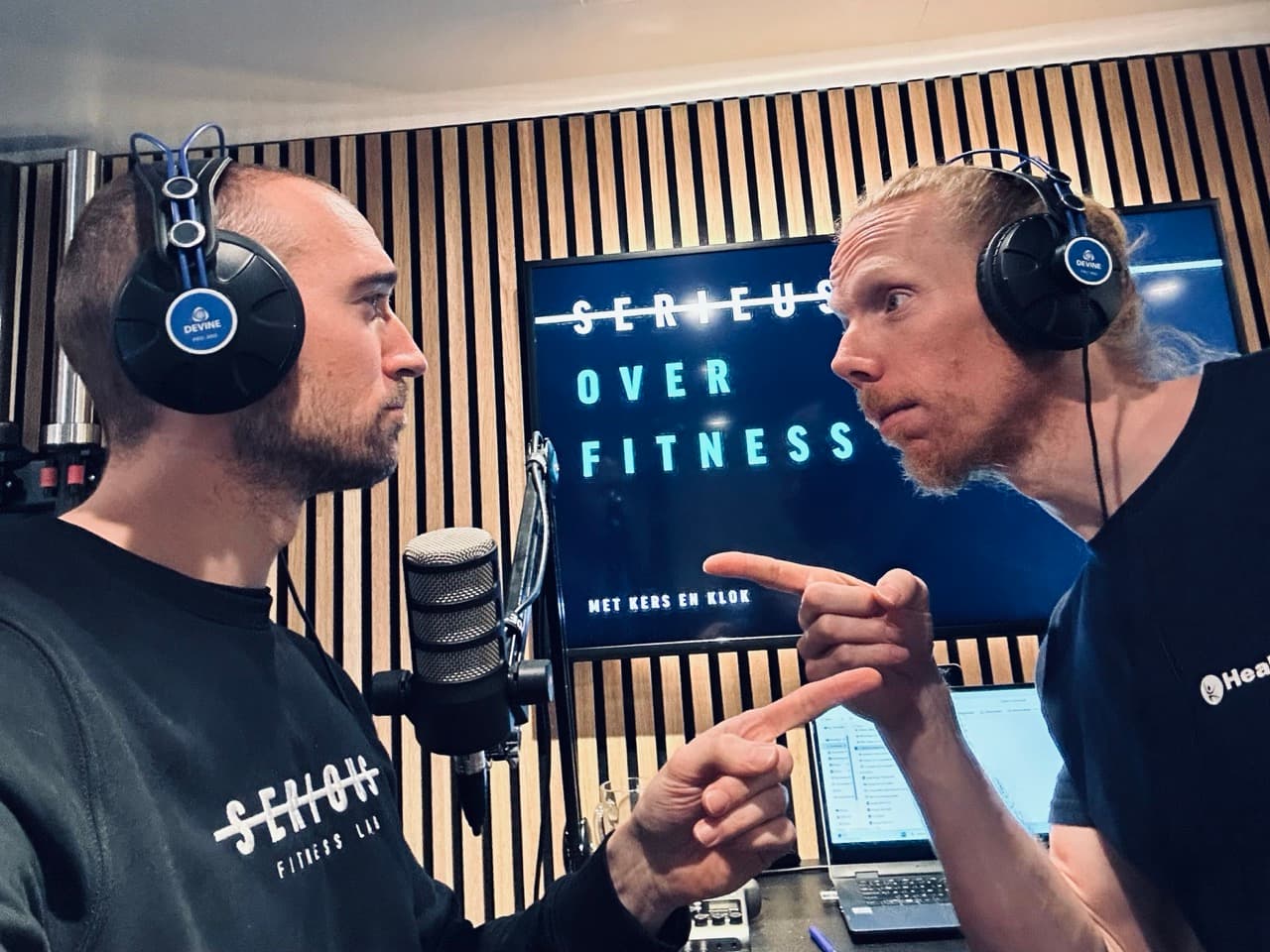
In podcast episode 80 of "Serious about Fitness (only in Dutch)" exercise scientist Sander Kers and cohost Tijs Klok examined 8 popular fitness statements. No long stories this time, but short, concise answers to questions that everyone asks themselves. From protein intake during weight loss to strength training for children.

Statement 1: Whenlosing weight, it's best to eat more proteins
The answer: It depends.
"Actually, you just need to keep eating the same amount of proteins, just a bit less of the other stuff," Tijs explains during the podcast. Sander adds: "You just need a calorie deficit, so more exercise and slightly less food."
The nuance
For advanced individuals with a lot of muscle mass, aim for around 1.6 grams to 2.0 grams of proteins per kilogram of body weight per day. Research shows that an increased protein intake (1.3+ grams per kilogram of body weight) helps better in preserving muscle mass during weight loss than a lower protein intake, but it's not a miracle solution.
Practical: Skip a meal, make 1-2 meals smaller, or remove fats from certain meals. As Tijs says: "I remove my peanut butter - that already saves a lot of calories from fat."
Statement 2: You need to do much less to maintain your body than when you want to make progress
The answer: True.
Sander explains it simply: "If you want to build muscle mass or improve your fitness, you need to continuously challenge your body. Once you reach your desired level, you can maintain your body with a (significantly) lower frequency."
The key: intensity
"You still need to reach your peak intensity," emphasizes Sander. "If you normally run at 12 km/h, you won't get a clear 'maintenance stimulus' if you just do a short jog. This also applies to bench pressing: if you normally do ten repetitions at a hundred kilos, then once every two weeks you need to do those ten repetitions at a hundred kilos."
Practical: Going from training six times a week to two times is often enough to maintain a large part of your progress, as long as you maintain the intensity.
Statement 3: The longer you walk in the sun without sunscreen, the more vitamin D you produce
The answer: False.
"After ten minutes, your vitamin D is completely saturated," explains Tijs. Sander confirms: Experts recommend 10-15 minutes of sun exposure for light skin, for maximum vitamin D production within this timeframe.
Why does the body stop?
"Your body is super smart," says Sander. After 10-15 minutes, you have already met your daily vitamin D needs. After that, your body largely converts excess vitamin D into inactive substances to prevent intoxication. People with darker skin need a bit longer, around 25-40 minutes, to achieve the same amount of vitamin D.
Practical: Ten to fifteen minutes of sun on your face and arms in the summer is sufficient. Longer sun exposure without sunscreen only increases your risk of sunburn and other negative consequences for your skin.
Statement 4: Intermittent fasting is healthier for your body than a traditional diet
The answer: False.
"There are studies showing it's healthier, and just as many studies showing it's not healthier," states Sander. Although intermittent fasting can be effective for weight loss, it remains unclear if there are specific benefits not related to calorie reduction.
The gut-cleansing story
Sander explains why the popular theory is incorrect: "Your intestines are constantly renewing their cells throughout the day. If they didn't, you would get very sick. Even if you were to eat for 16 hours a day."
Practical: As Tijs says: "Take it as it comes. Skipping breakfast occasionally is fine, but it's not a miracle solution."

Statement 5: You cannot lose localized fat
The answer: true (except with plastic surgery).
"It's not like you can do abdominal exercises to make the fat around your belly disappear," Tijs explains. Sander uses a strong metaphor from Tijs: "Compare it to a fuel tank. It doesn't first empty a bit on the left, then on the right, then in the middle. The whole tank gradually goes down."
The frustrating natural law
"Where you want it to go away first, it goes last," Tijs sighs. Unfortunately, this is true - your body determines where fat is stored and broken down, not you.
Practical: Focus on overall weight loss through calorie deficit. Spot reduction simply does not exist.
Statement 6: Animal proteins are better than plant proteins
The answer: not necessarily, but they are more complete.
Sander emphasizes first: "We don't care how you eat. Whether you are an omnivore, vegetarian, or vegan - eat the way you want." But looking at quality: animal proteins are theoretically more complete because they have a complete amino acid profile.
The plant-based solution
If you eat plant proteins and mix one or two sources, you can also get a complete amino acid profile. The only difference is that now you need two or more different sources instead of one.
Practical: Both can work perfectly. Plant-based eaters should consider B12, iron, and omega-3. The benefits of plant-based (protein-rich) products are that you probably get more fiber, vitamins, and minerals.
Statement 7: 80% of weight loss happens in the kitchen
The answer: Misleading marketing phrase.
Tijs clarifies: "It's easier to cut calories in the kitchen, but ultimately it's about the whole routine - sleep, exercise, and nutrition together."
The bag of chips example
Sander gets specific: "In such a large bag of chips, there are 1300 calories. How long does it take to eat it all? Fifteen minutes, half an hour? But think about how long it takes to burn 1300 calories by walking."
Practical: Successful weight control requires time with a combination of (small) adjustments to diet, exercise, and lifestyle factors. It's not about appealing 80-20 ratios.
Statement 8: Strength training does not limit children's growth
The answer: True.
"That used to be thought," Sander explains. "I wanted to start working out five years earlier, but my parents wouldn't allow it, because 'you might not grow fully.'"
What does science say?
This persistent myth is outdated. The more exercise you do, the more motorically developed you become.
Practical: Any form of movement is good for children (and adults). Strength training does not inhibit growth, but build it up gradually.

Selection from the references
[1] Helms, E.R., Zinn, C., Rowlands, D.S., & Brown, S.R. (2014). A systematic review of dietary protein during caloric restriction in resistance trained lean athletes. International Journal of Sport Nutrition, 24(2), 127-138.
[2] Garthe, I., Raastad, T., Refsnes, P.E., & Sundgot-Borgen, J. (2011). Effect of two different weight-loss rates on body composition and strength and power-related performance in elite athletes. International Journal of Sport Nutrition, 21(2), 97-104.
[3] Religi, A., Backes, C., Chatelan, A., Bulliard, J.L., Vuilleumier, L., Moccozet, L., ... & Vernez, D. (2019). Estimation of exposure durations for vitamin D production and sunburn risk in Switzerland. Journal of Exposure Science & Environmental Epidemiology, 29(3), 408-418.
[4] Holick, M.F. (2013). Sunlight and vitamin D: A global perspective for health. Dermato-Endocrinology, 5(1), 51-108.
[5] de Cabo, R., & Mattson, M.P. (2019). Effects of intermittent fasting on health, aging, and disease. New England Journal of Medicine, 381(26), 2541-2551.
[6] Donnelly, J.E., Blair, S.N., Jakicic, J.M., Manore, M.M., Rankin, J.W., & Smith, B.K. (2009). American College of Sports Medicine Position Stand: appropriate physical activity intervention strategies for weight loss. Medicine & Science in Sports & Exercise, 41(2), 459-471.
[7] Malina, R.M. (2006). Weight training in youth-growth, maturation, and safety: an evidence-based review. Clinical Journal of Sport Medicine, 16(6), 478-487.
[8] American Academy of Pediatrics. (2020). Strength training by children and adolescents. Pediatrics, 145(6), e20201011.
START TRAINING SERIOUSLY
Discover new training methods based on scientific knowledge, improve your form and technique and seriously track your fitness goals.